As I move through the changing landscapes of my life, I keep returning to a quiet, steady truth: every relationship I hold—family, friendship, partnership, creative collaboration, or community—shapes the texture of my inner world. Each bond carries its own gravity, its own influence, its own invitation to grow.
Over the years, I’ve learned that the wisdom in don’t invest in someone who doesn’t invest in you is not sharp or defensive. It is tender. It is clarifying. It is the kind of truth that arrives when I finally listen to what my own energy has been trying to tell me.
I’ve known relationships where I was the one who kept the flame alive—where the conversations moved because I pushed them forward, where the care flowed mostly in one direction, where my presence was offered but not truly met. These moments didn’t make me naïve; they revealed how deeply I wanted connection to flourish.
But I’ve also learned that reciprocity is the heartbeat of healthy relationships. Every connection breathes through mutual presence, shared responsibility, and a willingness to meet each other with honesty. When that balance fades, I feel it. Something in me strains to compensate, and I start shrinking to maintain what no longer has the structure to stand.
Choosing not to invest in places that do not nourish me is not an act of rejection. It is an act of restoration. It is me returning to the centre of my own field, gathering back the energy I scattered in hope, and honouring the truth that my care is a precious resource—not something to be spent in silence.
And when I honour that truth, my world shifts. Space opens. My breath deepens. I find myself drawn into relationships—of every kind—that meet me with readiness and respect. People appear who show up without prompting, who hold their part of the bridge, who recognise that connection is something we build together.
This clarity doesn’t close my heart; it refines it. It guides me to place my energy where it can echo and expand. It reminds me that I am at my best when I’m in relationships that understand the value of mutual investment.
Because when the exchange becomes balanced and alive, every connection—family, friendship, love, or creative partnership—becomes a vessel for evolution.
Below is a clear, explanation of the commonly referenced 12 “Laws of Karma.” These aren’t literal laws but a modern synthesis drawn from Buddhist, Hindu, yogic, and transformational frameworks.
They function as psychological and behavioural principles that influence the trajectory of a person’s life.
1. Cause and Effect → The brain’s quiet ledger It’s remarkable how the mind keeps score. Every action, every intention plants a seed in the nervous system. Over time, those seeds grow into patterns—reinforced, repeated, and eventually embodied. We live inside the consequences we’ve rehearsed.
2. Creation → The sacred responsibility of agency Life doesn’t merely unfold; we participate in its formation. Neuroscience calls it a sense of personal agency, but it feels more like the quiet knowing that we are co-authors. What we choose, repeatedly and consciously, shapes the path under our feet.
3. Humility → Meeting oneself without distortion Humility isn’t smallness; it’s clarity. When we’re willing to see the unvarnished truth of our behaviours and motives, the fog of bias begins to lift. In that honesty, transformation finds its opening.
4. Growth → The brain’s willingness to rewrite itself Neuroplasticity is simply the scientific name for an ancient truth: we are not fixed. With practice and intention, the brain rewires, habits shift, identity softens into something more expansive. Growth begins inside long before the world reflects it back.
5. Responsibility → The art of choosing our response Life brings its storms, but our emotional landscape is shaped by how we interpret and respond to them. The research calls it “cognitive regulation,” but in lived experience, it feels like reclaiming our sovereignty—moment by moment.
6. Connection → The invisible threads that bind everything We exist inside a network of influences—family, memory, environment, belief. Nothing is isolated. Each choice we make sends ripples outward, touching far more than we can see.
7. Focus → The compass of attention Where the mind rests, life follows. Attention is limited, sacred, and powerful. When we scatter it, we dilute our becoming. When we devote it, we enter alignment with who we are trying to become.
8. Giving and Hospitality → Embodied values Generosity is not an idea; it is a nervous system action. When we offer support, compassion, or presence, the brain responds with warmth, trust, and connection. Our values only become real when we live them.
9. Here and Now → The grounding that frees us The past can echo, and the future can beckon, but clarity happens here. Mindfulness pulls us back into the immediacy of lived experience, where decisions become clearer and the heart steadier.
10. Change → The soul’s pattern-breaking Life repeats its lessons until we meet them fully. Neuroscience describes this as revising or reshaping our mental frameworks —the rewiring of deep patterns. In lived experience, it feels like awakening to a doorway that we’ve been walking past for years.
11. Patience and Reward → The long arc of devotion Transformation asks for steadiness. The ability to wait, to nurture a vision without demanding immediacy, strengthens the brain’s reward pathways and anchors long-term change. Some of the most meaningful outcomes arrive slowly, but unmistakably.
12. Significance and Inspiration → The quiet legacy of every act Every gesture, no matter how small, has an influence on the world. Purpose activates deep layers of meaning within the mind. When we act from that place, we not only shape our own path—we inspire others to step more fully into theirs.
I have been revisiting an early chapter of my life lately — one I thought had already dissolved into understanding. When I was four years old, I had to leave my father. The circumstances were painful, shaped by elements of abuse toward my mother and me. I won’t go into the details, but what matters is the shift that happened inside me from that moment on. Something rose in me, a self-protective vigilance, and I stepped into a version of adulthood no child should ever have to carry.
My father never supported me in my life after that, not financially and not emotionally. And almost without knowing it, I took up the role of provider and protector. I became the one who must make ends meet, who must stay alert, who must keep the emotional sky from falling. Even now, I can feel the echo of that child who believed she had to be the one to hold her own world together.
It’s astonishing how these early imprints continue to ripple through our lives, even decades later. I am nearly 67, and I’ve forged an extraordinary story of dignity, strength and hope. And have accomplished many wonderful things in my life, including creating an amazing transformational tool, guiding others through profound transitions, and writing three books on healing yourself, owning your story, and embracing your spiritual evolution. I have lived as both student and teacher of transformation. And yet, here I am, arriving at a place I never knew was still waiting in the landscape of my own story. It has been nudging me gently, yet it has taken me by surprise.
Even with all my tools, wisdom, and lived experience, something tender has been rising, the old feeling of needing to be an adult too soon, resurfacing like a forgotten song.
You see, forgiving my father came long ago, as did compassion. But some stories lodge themselves in the body, not the mind, and they wait for the right moment to be rewritten. I am beginning to understand that this moment of healing is connected to my art, with me finally and fully claiming myself as an Artist.
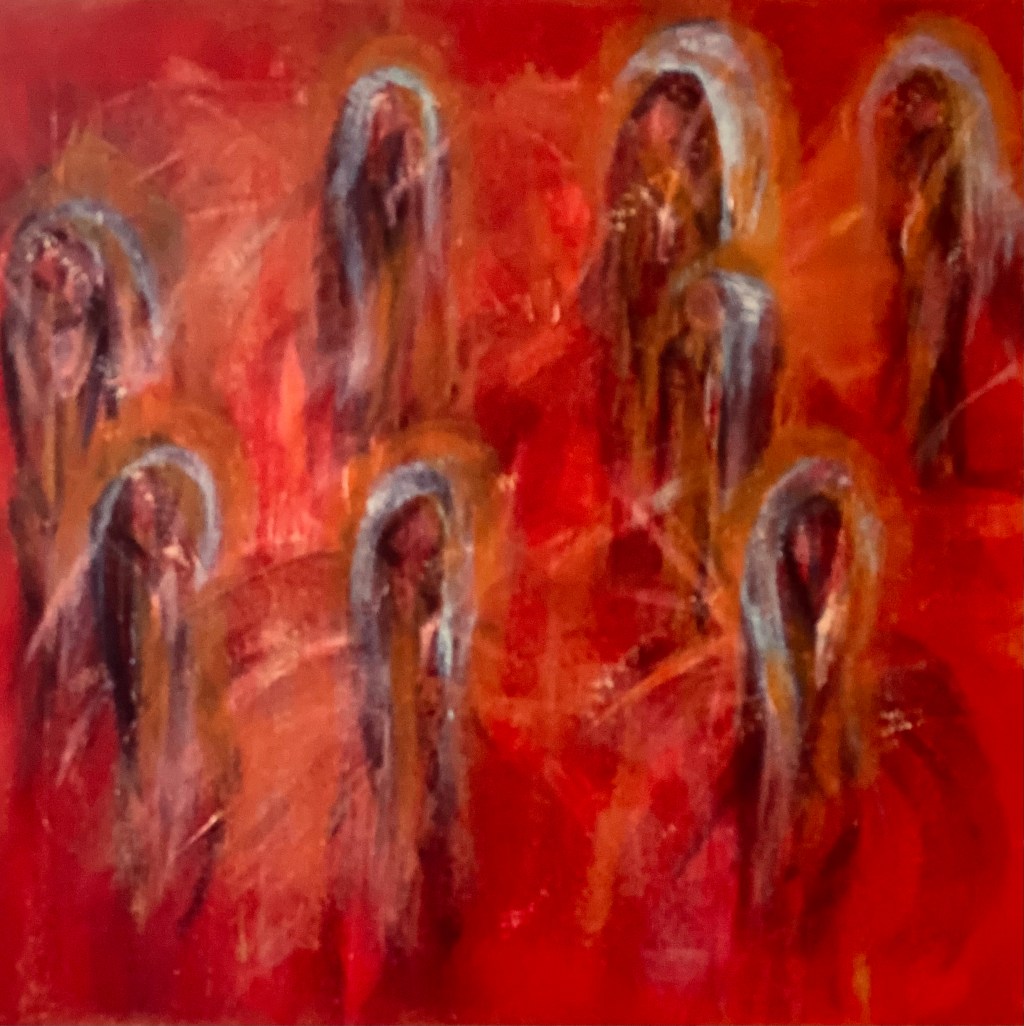
Because drawing and painting were the one thing my little self truly loved. It was my sanctuary. My joy. My untouched realm of innocence and wonder. As I open myself to this identity wholeheartedly, it feels as though I am stepping back into the place where I once felt totally free and at ease in the world.
This form of creative expression is awakening a part of me that never had the true luxury of childhood. With every creation I embrace, I can feel her coming closer. In every choice of colour, I sense her presence again. It is as though she trusts me now and trusts that I can hold what she could not.
This season of my life feels like a gentle rite of passage.
Not into adulthood because like U said I did that a long time ago. But into an inner holiday, a newfound gentleness, and an inner homecoming, all coming together as one sweet sigh of deep gratitude.
I am learning to speak to that four-year-old with the voice of the elder she never had. I am letting her know that the danger is long gone.
I am letting her know she doesn’t have to make ends meet, emotionally or spiritually, ever again. I am letting her know she is allowed to play, to create, to be messy, to explore and to have, at last, the childhood she lost.
Perhaps this is the true gift of growing older: a ripening into softness, a return to what was once abandoned, a liberation from the roles we had no choice but to inhabit.
I am ready to let the little girl play. And I am prepared to hold her with tenderness. I am ready to paint her back into wholeness.
And in doing so, I am allowing a new story to take shape, the one where survival no longer leads the way, and the Artist within me finally steps into the light she always carried.
Today, I am sharing a few insights with you; they may appear eclectic, but bear with me, they are indeed connected.
Listening to the Heart’s Invitations
Recently, a steady stream of inner guidance has been asking me to drop more deeply into my heart. These messages feel like preparation for the Heart-Centred Meditation series I’m developing, yet they also carry something more personal, an initiation into a different way of understanding the heart itself.
One insight arrived with particular clarity: the heart is not a single centre, but a network that extends into the palms of the hands and the soles of the feet.
In this way, the body holds five heart centres, the primary heart in the chest, and four extensions that radiate its field. This explains what I’ve experienced for so long: waves of warmth in my palms, tingling in my feet, and currents of energy that rise whenever I enter heart-centred practice. These sensations are not peripheral. They are the heart speaking through its wider circuitry.
Animal Wisdom Across Lifetimes
As this understanding has unfolded, another awareness has deepened, my long relationship with animals and the wisdom they carry. In the Living Attributes Framework, animal wisdom is aligned with one’s instincts. Since the time Bruce the kangaroo visited us, I’ve felt an awakening of this instinctual realm. And recall the many dreams over the years, of animal spirits in my garden who are frequent, vivid, and purposeful.
I know now that these beings are not merely symbols. They are soul companions. Some may be from the past, or some perhaps from the future, arriving to align with me in this moment.
I feel the presence of one companion, especially Ruan, a lion/lioness whose spirit has travelled with me across lifetimes. Ruan is both guardian and kin, an embodiment of courage, sovereignty, and fierce devotion. In other lives, Ruan’s presence protected me like a shield, offering a safety that still echoes through my instincts today. Although not physically present in this lifetime, Ruan’s majestic and loving presence continues to guide me, reminding me how blessed I am to walk among so many expressions of animal wisdom even now.
Shadow Dwellers and the Lore of Balance
With this renewed sensitivity has come a clearer understanding of shadow dwellers—habitual or shadow spirits that accompany the angelic rays. Someone asked at Temple recently, “What is their purpose?” My answer rose instantly: to make us stronger.
The model of light and shadow attributes, along with the process of correction and transformation, was given for exactly this reason. I see it like this, if there is One Divine Unified Presence that creates all things, then shadow is not an accident. It is part of the balance that the cosmos is built upon. Growth requires variance, and consciousness deepens through encountering what challenges us.
A Lesson from the Land of the Dead
This truth echoed again while rewatching the series His Dark Materials. There is a scene in an episode exploring the Land of the Dead where a frightening creature saves Lyra fromfalling into a deep dust chasm. After flying into the chasm and rescuing her, Lyra gives the harpy called No-name a new name: Gracious Wings. And the harpies now discover the power of story. True stories are nourishing. They feed the harpies in a way that lies and wickedness could not. They agree to allow the dead safe passage out of the Land of the Dead, in exchange for their true stories. “Liars cannot pass!” the newly named Gracious Wings declares. The newly named harpy wants Lyra to get out so that she can tell the story of its new name.
Now here’s the part they left out in the show, the story of No-Name in the books tells Lyra and Will of their kind’s damnation:
“Thousands of years ago, when the first ghosts came down here, the Authority gave us the power to see the worst in everyone, and we have fed on the worst ever since, till our blood is rank with it and our very hearts are sickened. But still, it was all we had to feed on. It was all we had. And now we learn that you are planning to open a way to the upper world and lead all the ghosts out into the air …
What will we do now? I shall tell you what we will do: from now on, we shall hold nothing back. We shall hurt and defile and tear and rend every ghost that comes through, and we shall send them mad with fear and remorse and self-hatred. This is a wasteland now; we shall make it a hell!”
But it was Will, Lyra’s devoted companion and friend, who spoke up –“Harpies,” he said, “we can offer you something better than that. Answer my questions truly, and hear what I say, and then judge. When Lyra spoke to you outside the wall, you flew at her. Why did you do that?”
“Lies!” the harpies all cried. “Lies and fantasies!”
Will, replied, “Yet when she spoke just now, you all listened, every one of you, and you kept silent and still. Again, why was that?”
“Because it was true,” said No-Name. “Because she spoke the truth. Because it was nourishing. Because it was feeding us. Because we couldn’t help it. Because it was true. Because we had no idea that there was anything but wickedness. Because it brought us news of the World, the Sun, the Wind,and the Rain. Because it was true.”
I now understand this passage and why it has stayed with me so deeply. Even the shadow longs to be acknowledged, not because it seeks praise, but because everything that exists wishes to belong in the story of all life. To give life is to include all of it, the light, the shadow, the parts we fear, and the parts that have saved us.
The Little Gold Locket
This understanding also returned to me in the form of a small gold heart locket, one my father gave me for my seventh birthday. My parents had now divorced, my father had struggled to be a good father because of alcohol and substance addiction, and was deeply entangled in his own emotional pain. Years later, burdened by old wounds, I decided to throw the locket into the garden, wanting to bury the memories that felt too heavy to carry.
But the locket found its way back.
While clearing the garden, my partner unearthed the locket unexpectedly and handed it to me. It felt almost conscious, as if it had waited for the moment it knew I would be ready to receive it again.
Now, approaching my 67th year, I finally understand its symbolism. It was never a token of what my father failed to be. It was an offering of what he longed to give. It was a gesture of hope from a man who wished he could have been better, but who still wanted to offer something beautiful to his little daughter.
The locket, like Gracious Wings, whispered: “Include me in your story. Don’t leave me in the shadows.”
The Story That Makes Us Whole
Today I reclaim the locket as part of my story, not the wounded part, but the part that brought strength, beauty, tenderness, and a deeper sense of divinity into my life. I honour the man who gave it to me, not for perfection, but for the small gesture of his love and his humanness with all its flaws.
This is the lore of life on Earth: Every presence must be acknowledged for the story to be whole.
The heart knows this. The animals know it. The shadows know it. And the locket knew it too.
In many esoteric traditions, the temple has always symbolised far more than a sacred structure; it is the living architecture of the soul. Each pillar represents sacred knowledge, each chamber a hidden facet of consciousness awaiting illumination. We are the builders of this inner sanctuary, and are called to summon and integrate every part of our being, light and shadow alike, until we stand whole in divine harmony.
Within us live many forces that are both shadow and angelic by nature, and move as archetypal expressions of our inner world. These are not external beings but elemental forces of consciousness. The shadow spirit reveals what has been denied, and the angel ray reveals what is possible. Together, they form the sacred circuitry of the self.
When we repress the shadow, we become ruled by it, bound to unconscious impulses and fragmented expression. Yet when we seek only light, clinging to purity and transcendence, we sever our connection to the earth and our true essence. Our mastery lies not in escape but in balance, the sacred marriage of heaven and earth within.
The path to wholeness invites us to:
Acknowledge the shadow with awareness and courage.
Transform its destructive charge into creative power.
Balance it through the virtues of Angelic Light.
Align that power with our higher purpose.
The Alchemy of Integration
Modern mystics, Jungian psychologists, and spiritual practitioners describe this inner work as shadow integration, the conscious art of reconciling light and darkness within. My Living Attributes Typology is a subtle yet metaphysical framework that explores how habitual or shadow spirits attach to specific aspects of one’s flawed character, revealing the architecture of the unseen self.
I can say with confidence that this framework offers profound insight and continues to serve as an inner compass for my own growth and transformation. Each shadow aspect represents an unrefined energy, a creative impulse, a potent current that can either bind or liberate, depending on how it is met and transmuted.
When the angelic and shadow aspects are brought into dialogue and when light meets its reflection, a sacred alchemy begins. The psyche harmonises, and the fragmented inner temple becomes whole. This integrative practice involves pairing each shadow aspect with its angelic counterpart according to one’s unique configuration of archetypes, referred to as Light and Shadow Attributes within the Correct and Transform process.
The four essential movements of this process are: Identify, Clarify, Specify, and Unify.
Identify what you are feeling or experiencing: Acknowledge the shadow with awareness and courage.
Clarify why you are feeling this way: Transform its destructive charge into creative power.
Specify what you truly desire: Balance and refine the impulse through the virtues of Angelic Light.
Unify by living your realization: Align that renewed power with your higher purpose.
Through this alchemy of integration, the light and the shadow are not adversaries but partners in evolution and the very dance through which the soul remembers its wholeness.
For example, within the Queen archetype, the shadow attributes may express as weakness, jealousy, or destructive qualities that obscure her innate sovereignty.
Yet, in this case, when one aligns with theAngelic Ray of Camael and embodies strength, trust, and benevolence, the Queen’s authority becomes luminous. Her power softens into heartfelt responsibility, and her leadership becomes love in action.
Each Shadow Spirit thus can stand as a gatekeeper, and each Angel Rayas a guiding force. The key is we must be awake to the true nature of our own psyche.Together, they restore the sacred geometry of the soul; a radiant temple where the human and divine coexist in unity.
We live in an era that celebrates connection but quietly erodes attention. Our thumbs scroll, our minds race, and our souls wait—patiently—beneath the noise. The modern human is data-rich but meaning-poor. We know more, yet understand less. The world offers us infinite surfaces, but growth now demands that we go deep.
Depth Is the New Intelligence
True intelligence is not measured by how much we consume but by how deeply we engage. Neuroscience shows that the brain’s prefrontal networks—those responsible for insight, empathy, and creativity—activate most powerfully when we slow down and allow for sustained focus. Scrolling disperses our attention; reflection gathers it back into coherence.
Every time we pause long enough to feel, listen, or contemplate, neural integration occurs: different experiences knit together into a tapestry of understanding. This is the biological basis of wisdom. Awareness deepens not through information, but through integration.
The Evolution of Awareness
Human evolution is no longer about survival—it’s about consciousness. We are now shaping not just our external environment, but our internal one. The next leap in evolution will not be genetic but perceptual: the expansion of awareness beyond the reflexive patterns of distraction and reaction.
Spiritual teachers have long intuited what science is now beginning to confirm: awareness itself is transformative. Meditation research at Harvard, Stanford, and the Max Planck Institute shows that consistent contemplative practice strengthens neural pathways associated with attention, compassion, and emotional regulation.
In other words, going deep literally restructures the brain—we become more present, more awake, more human.
The Attention Economy vs. the Inner Economy
The world we inhabit profits from our distraction. Each swipe and click trains the nervous system toward fragmentation. But beneath that constant motion lies another economy—the inner economy—where value is measured not in likes or views, but in presence, insight, and stillness.
To reclaim that economy, we must treat attention as sacred currency. Every moment we give to silence, every conversation we inhabit fully, every question we sit with rather than rush to answer and reading long-form content (like this blog post)—these are acts of quiet rebellion against a culture of haste.
Depth is not withdrawal. It’s engagement with essence. It’s choosing to sense rather than scroll, to witness rather than react, to inhabit reality instead of escaping it.
Practicing Depth in the Everyday
Depth is not found in monasteries alone—it’s cultivated in daily life. Begin with simple, radical acts of awareness:
Breathe before you respond. That single pause transforms reactivity into consciousness.
Read slowly. Let ideas digest rather than drown you.
Observe your mind. Watch it crave novelty, then gently guide it back to stillness.
Choose presence over performance. Life unfolds in moments, not metrics.
Each act of attention reclaims a piece of your consciousness from the machinery of distraction. Over time, this becomes spiritual strength—the capacity to dwell fully in reality as it is.
The Future Belongs to the Deeply Awake
To grow now is to go deep. To evolve is to cultivate awareness in a world designed to scatter it. Our collective future depends on individuals willing to anchor stillness amid speed, to seek understanding over accumulation, and to remember that the quality of our consciousness shapes the quality of our world.
Depth is not an escape from modern life; it is our way forward. Because what the world needs now is not more information—it’s more awareness. And your willingness to go deep may well be the most revolutionary act of all.
Heart to Heart Elizabeth
Thank you for reading my blog post. I hope it was of value to you. Please subscribe to receive future blog posts.