The Child Who Became An Adult Too Soon

Hello wondrous Souls,

I have been revisiting an early chapter of my life lately — one I thought had already dissolved into understanding. When I was four years old, I had to leave my father. The circumstances were painful, shaped by elements of abuse toward my mother and me. I won’t go into the details, but what matters is the shift that happened inside me from that moment on. Something rose in me, a self-protective vigilance, and I stepped into a version of adulthood no child should ever have to carry.

My father never supported me in my life after that, not financially and not emotionally. And almost without knowing it, I took up the role of provider and protector. I became the one who must make ends meet, who must stay alert, who must keep the emotional sky from falling. Even now, I can feel the echo of that child who believed she had to be the one to hold her own world together.

It’s astonishing how these early imprints continue to ripple through our lives, even decades later. I am nearly 67, and I’ve forged an extraordinary story of dignity, strength and hope. And have accomplished many wonderful things in my life, including creating an amazing transformational tool, guiding others through profound transitions, and writing three books on healing yourself, owning your story, and embracing your spiritual evolution. I have lived as both student and teacher of transformation. And yet, here I am, arriving at a place I never knew was still waiting in the landscape of my own story. It has been nudging me gently, yet it has taken me by surprise.

Even with all my tools, wisdom, and lived experience, something tender has been rising, the old feeling of needing to be an adult too soon, resurfacing like a forgotten song. 

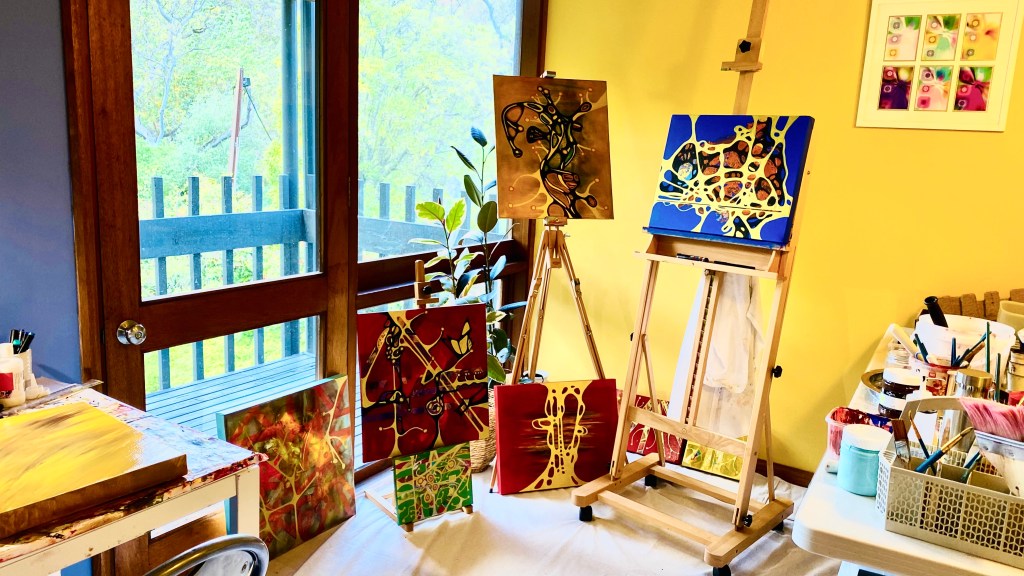
You see, forgiving my father came long ago, as did compassion. But some stories lodge themselves in the body, not the mind, and they wait for the right moment to be rewritten. I am beginning to understand that this moment of healing is connected to my art, with me finally and fully claiming myself as an Artist.

Because drawing and painting were the one thing my little self truly loved. It was my sanctuary. My joy. My untouched realm of innocence and wonder. As I open myself to this identity wholeheartedly, it feels as though I am stepping back into the place where I once felt totally free and at ease in the world. 

This form of creative expression is awakening a part of me that never had the true luxury of childhood. With every creation I embrace, I can feel her coming closer. In every choice of colour, I sense her presence again. It is as though she trusts me now and trusts that I can hold what she could not.

This season of my life feels like a gentle rite of passage.

Not into adulthood because like U said I did that a long time ago. But into an inner holiday, a newfound gentleness, and an inner homecoming, all coming together as one sweet sigh of deep gratitude. 

I am learning to speak to that four-year-old with the voice of the elder she never had. I am letting her know that the danger is long gone. 

I am letting her know she doesn’t have to make ends meet, emotionally or spiritually, ever again. I am letting her know she is allowed to play, to create, to be messy, to explore and to have, at last, the childhood she lost.

Perhaps this is the true gift of growing older: a ripening into softness, a return to what was once abandoned, a liberation from the roles we had no choice but to inhabit.

I am ready to let the little girl play. And I am prepared to hold her with tenderness. I am ready to paint her back into wholeness.

And in doing so, I am allowing a new story to take shape, the one where survival no longer leads the way, and the Artist within me finally steps into the light she always carried.

Heart to Heart, Elizabeth

The Hidden Danger of the Ordinary

Hello, wondrous Souls,

Today I am talking about being extraordinary…

We’re often taught that “ordinary” is safe. That if we stay in our lane, play by the rules, and blend into the beige backdrop of convention, we’ll be rewarded with a quiet life. But let me offer another view—not a radical rebellion, but a soul truth: ordinary can be a slow seduction into mediocrity, sameness, and complacency.

It’s subtle at first. The ordinary offers us comfort, predictability, and a version of belonging. But left unchecked, it begins to dull the edges of our creativity, our daring, and our evolutionary spark. What once served as a haven of rest can become a rut of resignation.

Ordinary becomes sameness.
Sameness becomes stagnation.
And stagnation leads to entropy and the unravelling of life’s vital impulse.

We are not meant to stay still for too long. Life itself is motion, breath, transformation. When we settle into the ordinary and call it enough—without examining if it’s still true, still alive for us—we begin to betray the divine within.

Because here’s the deeper truth: we are not designed to stop becoming.

The yearning to grow, to evolve, to reach beyond what is known—it’s not selfish. It’s sacred. It’s part of the holy code written into our DNA. We are meant to push boundaries—not always in big, showy ways, but in authentic, soul-stretching movements that pull us closer to who we really are.

And look again at the word live. Now flip it: evil.

What stops life, what stifles it, denies it, dulls it, becomes its opposite. Anything that blocks the life force within us, cages our spirit in sameness, and suppresses the call to grow becomes a shadow force. A kind of quiet death.

And yet—many who appear ordinary are living extraordinary lives.

The poet who writes by candlelight, unseen by the world.
The healer whose laughter transforms pain in the checkout line.
The elder who carries stories like sacred seeds, planting them in the hearts of her kin.

These lives are not mediocre. They are alive. They pulse with intention, wonder, and presence. The difference is not in appearance—it is in awareness.

So let us not confuse ordinary with alive.
Let us not glorify sameness when it becomes a cage.

Let us honour the ordinary only when it is infused with devotion, purpose, and soul.
Let us rise from mediocrity, not to chase fame or perfection, but to become fully ourselves.

This is the true extraordinary life: one that resists complacency, that listens deeply, that dares to grow.

Because mediocrity is not just a lack of excellence—it’s a lack of aliveness.
Sameness is not just uniformity—it is forgetting the wild uniqueness of our own soulprint.

And evolution is inner, sacred, and radiant—it is our natural way forward.

So awaken, Beloveds. Live. Burn bright. The world needs your passion.

Heart to Heart, Elizabeth

Seeing the Scars, But Not the Story

Hello wondrous Souls,

Today I am talking about perception…

I always begin my presentations by sharing parts of my story to set the context of my brand. However, after a talk I gave to a large group of women on personal branding through archetypes, I was approached by someone who lingered back as the crowd thinned. They came up to me, eyes earnest, voice soft, and said:

“I’m so sorry that happened to you. I had a perfect childhood… I can’t imagine going through what you did.”

Then, without pause, they added:

“Imagine who you could have been if that hadn’t happened to you.”

Her words landed with a confused thud; they carried no malice but something subtler—more revealing. In that moment, I smiled gently, nodded graciously, and allowed her to speak her truth.

Later, in the quiet of my heart, I felt the need to sit with it—to feel it fully and sense what it might be pointing to, not just in terms of her understanding but also in how our stories are received, filtered, and sometimes misunderstood. Perhaps it was a moment shaped by her lifes lens—by unspoken wounds, cultural conditioning, or a need to make sense of my experience through her framework.

And, of course, there’s always the possibility that what was spoken was less about me and more about the quiet projections of her own subconscious beliefs—surfacing in response to something unprocessed within herself.

The woman’s comment came not from cruelty but from a lens shaped by simplicity—perhaps even pity and privilege. It struck me that suffering was a detour, an interruption to potential in her world. In mine, it was the fire that forged my authenticity. I don’t say that lightly. Pain doesn’t always make us stronger, but when we consciously work with it, it certainly makes us deeper.

There was a time when I, too, longed for a “perfect” past. One untouched by trauma. But that longing was now a ghost. My real growth began when I stopped seeing myself as broken and started seeing myself as a resilient and creative human being. Not despite my story—but because of it.

This person was indeed a gift and gave me another perceptive of how others may not see who I am due to the lens they choose to view life. Thankfully, for me the archetypes that inform my reality—The Alchemist, The Visionary, The Divine Child and The Queen—were not born out of a perfect world. They emerged gifting me all their light and shadow attributes—through my cracked-open places and the trials, challenges and initiations handed to me early in life.

If you only see the scars, you miss the magic and message in the story.

My truth is this: There is no version of me more powerful than I am now. Not the one who never experienced pain, not the one who was spared from a challenge. This version—right here, right now—results from soul-forging choices, courage in the face of fear, and a relentless devotion to turning wounds into wisdom.

And perhaps that is what we are here to do: not explain our story to be understood, but embody it so clearly, so confidently, so sacredly that others are invited not to pity us—but to look within themselves and ask, What am I not seeing about myself ?

So, to the gorgeous human being who approached me: I thank you, honour you and your spirit. I see your truth. But I know this—I am not a lesser version of who I could have been.

I am the living, breathing story of who I came here to be and I’m eternally grateful for my extraordinary story.

Heart to Heart, Elizabeth

If you are inspired by what you’ve read?

You can dive deeper into your transformation by exploring my coaching sessions, workshops, and retreats. Let’s co-create a future where you step fully into your Souls Purpose. 

The Sacred Art of Boundaries: A Devotion to Self-Integrity

Hello wondrous Souls,

Today I am talking about “boundaries” – a hot topic that so many of us must face and understand.

There is a quiet power in the realisation that boundaries are not about others. They are not demands or ultimatums. They are not conditions set to control or manipulate. A boundary is a sacred agreement with yourself—a line drawn in devotion to your own integrity.

Dr. Becky Kennedy captures this truth so simply: “A boundary is something that requires nothing from anybody else other than you.” This shifts everything. It means that boundaries are not contingent on whether others honor them. They are not about enforcing consequences or waiting for validation. They exist because you choose them. Because you are the guardian of your own energy, time, and well-being.

Too often, we misunderstand boundaries as something we must convince others to accept. We fear setting them because we worry about how they will be received. But the moment we step into the truth that a boundary is ours alone to uphold, we reclaim our personal power.

A boundary is saying, I will not abandon myself for the comfort of another. It is choosing self-respect over external approval. It is allowing ourselves to walk away, to say no, to remain rooted in our truth—without explaining, justifying, or seeking permission.

This is where real transformation begins. When we stop waiting for the world to make space for us and instead claim the space we need. When we stop trying to manage others’ reactions and instead stand firm in our own clarity.

Managing a Boundary in Action: A Family Gathering Example

Imagine a father whose adult child repeatedly uses inappropriate language when speaking to him at a family gathering, despite addressing others respectfully. He may feel disrespected and uncomfortable but hesitate to confront them directly. However, honouring his boundary means he does not have to wait for their behaviour to change—he simply upholds his own standard.

In this case, he can calmly and firmly state, “I do not accept being spoken to in that way. If you continue to use this language, I will remove myself from the conversation.” No argument, no pleading—just a simple, non-negotiable truth. If they continue, he follows through and steps away. The power lies not in forcing them to change but in his commitment to maintaining his own self-respect.

Another Example: Work-Life Balance

Consider an individual who finds themselves constantly answering work emails late at night, despite their deep desire to maintain a healthy work-life balance. Their employer or colleagues may not explicitly demand this, but the pressure feels implicit. To uphold their boundary, they decide, “I will not check or respond to work emails after 7 PM.” They do not need their employer’s approval to implement this boundary—it is theirs alone to maintain. If a colleague reaches out late, they simply do not engage until the next workday. Over time, this reinforces their boundary and teaches others how they wish to be treated.

So, what boundary is calling to you now? Where have you been outsourcing your sovereignty, waiting for someone else to grant you permission to protect your peace? What would it feel like to embody the deep knowing that you are allowed to choose what serves you—without guilt, without apology, without needing a single thing from anyone else?

The path of the sovereign soul is one of self-honoring. The invitation is here. Will you answer?

Heart to Heart, Elizabeth

My Responsibility To You Is To Be Me

Hello wondrous Souls,

I remember the first time I heard Maya Angelou say, “When people show you who they are, believe them.” It resonated so deeply with me that I’ve carried it with me ever since.

Over time, though, I saw how my own life experience of Maya’s quote also had roots in one of my own life motto’s: 

My Responsibility To You Is To Be Me

This weaving of insights has brought me so much clarity. It reminds me that actions speak louder than words and that consistent behaviour is the true measure of a person’s character. And here’s the beauty of it—it applies to both the good and the not-so-good aspects of people’s nature.

Letting Go of the Need to Change Others

One of the most freeing lessons I’ve learned is this: You cannot change people. Only they can do that. When someone’s actions reveal their true nature—whether through patterns of negativity or behaviour that crosses your boundaries—it’s not your job to fix or shape them.

Instead, I’ve found peace by focusing on my own energy, creating space where needed, and managing my own expectations. Sometimes, that means creating physical or emotional distance. Even if someone is family or a long-time friend, I’ve learned that when their actions consistently don’t respect my presence and values, they may not be a friend ~ And that’s okay.

On The Positive Side

But here’s the other side of the coin, and it’s equally important: when people show you who they are in positive ways, believe them too.

Think of the friend who consistently shows up for you, the colleague who goes the extra mile, or the loved one who surprises you with kindness and understanding. When people reveal their goodness, their generosity, and their compassion, let that sink in. It’s easy to focus on the negative, but we can miss the beauty of the positive examples people offer every day.

Recognizing and valuing these moments deepens trust and connection. It allows us to honour the goodness in others and appreciate the people in our lives who uplift and inspire us.

Setting Your Guidelines with Clarity

For those who cross the line, are inappropriate or act disrespectfully, you can respond with grace and strength. Here’s one of my favorite approaches:

  • Pause. Allow for silence—a moment long enough to feel slightly uncomfortable.
  • Respond clearly. Say something like: “What you just said is below my standard for a response.” Another is: “My responsibility to you is to be me. So, I choose not to engage with what you just said.”

This clarity and calmness shift the dynamic without unnecessary confrontation. It’s a way to protect your peace while maintaining your integrity.

Celebrate the Good

On the flip side, when someone shows you their good nature, celebrate it. Tell them what you see in them. For example:

  • “I appreciate how thoughtful you’ve been lately—it really means a lot to me.”
  • “Your kindness inspires me to be a better person.”
  • “Thank you for always showing up with such grace and generosity.”

Acknowledging the good in people not only strengthens your relationships but also creates a ripple effect of positivity.

Peace Starts with You

At the end of the day, the way people show up in our lives is out of our control. What we can control is how we respond. When people show you who they are—whether through their challenges or their gifts—believe them.

Choose to protect your peace with those who drain you, and celebrate the light in those who uplift you. Life becomes richer when we honour the truth in others, while always staying true to ourselves.

Heart to Heart, Elizabeth

Connection and Correction

Hello beautiful Souls,

Today I am talking about our social and spiritual connection as humans…

Our true purpose in life is to build an energy vessel – a container where the Divine can be revealed.  And the practice of correcting and transforming our relationships with our family, friends and community is a key factor. 

It is through our “point of light” in the heart that we can build this vessel, which can only be achieved through connection and correction.

I often talk about connecting heart to heart and spirit to spirit – because this is how we can repair and grow our collective Soul. 

I encourage you to try connecting and correcting for the purpose of our collective transformation and Union.

Heart to Heart, Elizabeth