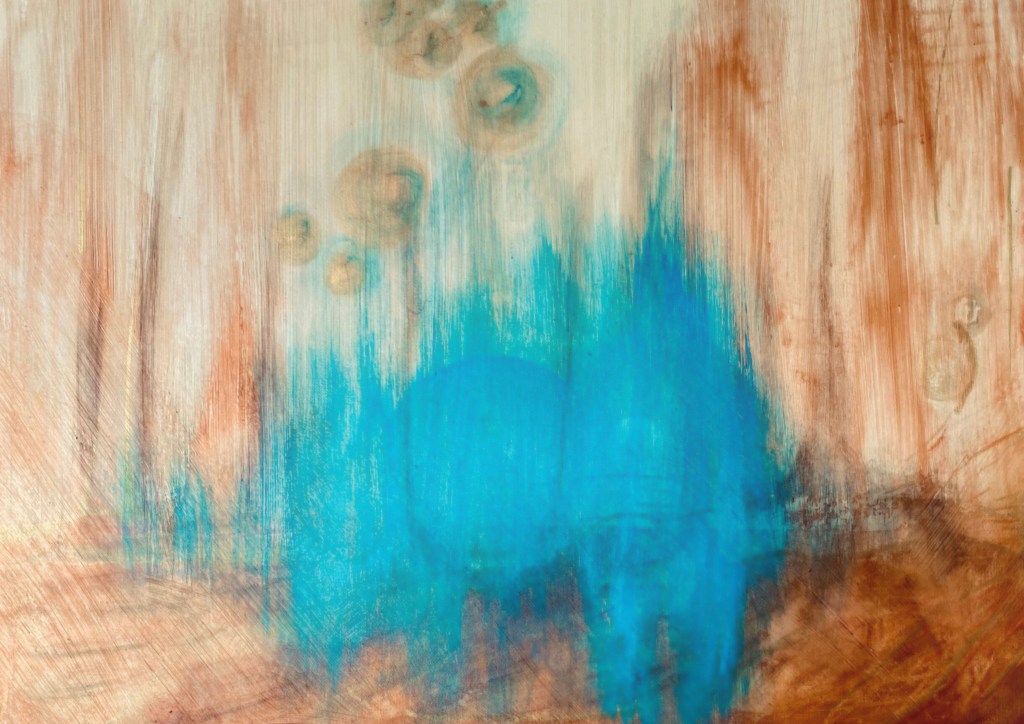
The day I declared, “I am an artist,” I unknowingly did something that would unexpectedly open a gateway, not in the outside world, but deep within my inner landscape. That doorway gave my spirit, my imagination, and my heart permission to rise, to move, to express without apology.
When I hear myself say, “My canvas is calling,” I am naming a sacred moment. It is not just a whim, nor a hobby, but a signal—a pulse from within that stirs me toward the imaginal.
This calling is not about perfection, nor about predictability. It is not about producing something to please the eye of another. It is the quiet, potent courage to let my true presence take hold and simply paint. In this way, art becomes more than my craft; it becomes a demonstration of what I call my authentic authority.
Authority, in this sense, is not control or dominance. It is a natural sense of being aligned with my deepest truth. I let go and trust what moves me and moves through me. When I listen to the call of my canvas, I honour the mysterious current that I guess runs through every artist—a whisper that insists I am more than a maker of things, I am a vessel for something eternal. And by the way, I had no idea that embodying my artist archetype would emerge with such emotional potency.
To answer this call is to give myself to the process of my visionary archetype. To trust that even the mess or accident has meaning. I am beginning to trust that when my canvas calls, it’s because I am ready to let my presence become visible, to let my soul become form, and to let art be the language of my freedom.
Because somewhere deep within me, I know that Art is Life and Life is Art
In a letter to her nephew, Phoebe Anna Traquair writes:
“To the artist, be he the poet, painter or musician, the world is a great treasure house, stored with endless material for him to use, teach yourself to match the beauty of red-lipped buds, sunlight through green leaves, the yellow gorse on the hill, the song of the wild birds, so on, step by step, the world opens out. This is life. This is to live, the perfection comes when one’s own life is in harmony with this beauty”
I recently stumbled upon an artist of remarkable depth and vision—though, in truth, I had already encountered her work without realizing it. For some time, I have been captivated by The Progress of the Soul, a breathtaking four-panel tapestry that speaks to the very essence of transformation and spiritual evolution.
Yet, until now, I had been unable to find other works in a similar style, and for good reason—the original source where I discovered the image had misattributed the piece! No wonder my search had felt like chasing shadows. But now, with her name illuminated before me, I am uncovering the brilliance of an artist whose legacy is far more expansive and profound than I first imagined.
THE PROGRESS OF A SOUL
The Progress of a Soul: The Entrance, 1895 (Panel One) Silk and gold thread embroidered on linen
This is the first from a suite of four embroidered panels which follow the journey of the human soul to heaven. It illustrates the happy stage of hope and innocence when the soul is in tune with nature, unaware of the realities of life. The theme was inspired by a performance of Richard Wagner’s opera Parsifal, which premiered in Germany in 1882. It was also loosely based on Denys L’Auxerrois (1887) by Walter Pater (1839-1894), a tale about the god Dionysus living as a priest in medieval France.
The Progress of a Soul: The Stress, 1897 (Panel Two) Silk and gold thread embroidered on linen
Here the forces of evil begin to invade the soul’s world and destroy all precious, living creatures. Hands reach out for flowers, birds and even the soul’s tunic, while a snake entwines one leg. The figure is reminiscent of both Orpheus (with his lyre) from Greek mythology and Denys l’Auxerrois. Pater described Denys, a character in a 13th-century tapestry, as a flaxen and flowery creature, sometimes well-nigh naked among the vine leaves … with all the regular beauty of a pagan god’.
The Progress of a Soul: Despair, 1899 (Panel Three) Silk and gold thread embroidered on linen
Pater described Denys l’Auxerrois as a ‘suffering, tortured figure’. – Traquair provided her own explanation of the embroideries, asserting that in this scene ‘frustration, disillusionment and despair have gained the upper hand’. She employed a vast range of coloured silks for each panel, using traditional and more fashionable stitches to create the rich, textured effect. They included laid and couched work (also used in the 11th-century Bayeux Tapestry) for the vine leaves.
The Progress of a Soul: Victory, 1902 ( Panel Four) Silk and gold thread embroidered on linen
Here the human soul is welcomed into heaven, awoken from death with a kiss from a red winged angel. According to Phoebe Anna Traquair, this final panel symbolised ‘ultimate salvation by the grace of Higher powers, rather than the merits of the individual’. She based the design around Pater’s description, not of Denys, but of a ‘wine-god who had been in hell’. As customs labels on the back of each panel confirm, all four embroideries were exhibited at the St Louis Exposition in the USA in 1904.
Phoebe Anna Traquair
Phoebe Anna Traquair was a force within the Celtic Revival and the Scottish Arts and Crafts Movement of the early twentieth century. Though celebrated as a Scottish artist, she was, in fact, born in Dublin, Ireland, in 1852. Her artistic journey began at the School of Design in Dublin, where she honed her craft before moving to Edinburgh in 1874. This relocation came after her marriage to Dr. Ramsay Traquair, a distinguished naturalist who would later serve as the Keeper of Natural History at Edinburgh’s Museum of Science and Art.
Traquair’s work was deeply influenced by the Pre-Raphaelites, William Morris, and the Arts and Crafts Movement, as well as the visionary mysticism of William Blake and the luminous storytelling of early Italian Renaissance painters—the very period that inspired the Pre-Raphaelite Brotherhood (so named for their reverence of art before Raphael). She corresponded with the eminent critic John Ruskin, was a friend of William Holman Hunt, and, through sheer dedication, carved out a career that earned her international acclaim as an artist, designer, and craftswoman.
Phoebe Anna Traquair
Her body of work is staggering in its range and ambition. While she produced a number of traditional paintings on canvas and panel, her artistry extended far beyond conventional boundaries. She was a master of mural painting, book illumination, embroidery, enameling, and tapestry, infusing each medium with an almost sacred quality—her work radiates with spiritual symbolism, intricate storytelling, and a sense of the divine feminine.
An incredibly skilled embroiderer, Phoebe Anna Traquair produced a body of stunning tapestries, including The Salvation of Mankind:
Phoebe Anna Traquair Phoebe Anna Traquair
Perhaps most astonishing is the sheer scale and vision of her mural work, particularly in Edinburgh. She transformed spaces into realms of transcendence, painting vast ecclesiastical frescoes that shimmer with otherworldly beauty. Her most famous murals, including those in Mansfield Traquair Church, have been likened to the Scottish equivalent of the Sistine Chapel—testament to her ability to fuse art, myth, and spirituality into something truly divine.
Phoebe Anna Traquair Phoebe Anna Traquair
Her legacy, once overshadowed by misattribution and historical oversight, is now being rightly reclaimed. The more I learn about Phoebe Anna Traquair, the more I feel she was not only an artist but a visionary—a woman who painted with a soul that spanned across time, bridging the mythic past with the ever-evolving present.
Have you encountered her work before? If not, I encourage you to dive into the luminous world she created—it is nothing short of awe-inspiring.
In every age, artists stand at the threshold of the unseen, the unspoken, and the yet-to-be-discovered. They are the first to articulate the unknown, weaving threads of whispers into form, word, image, and sound that awaken something ancient and infinite within us. It is their courage to commune with the intangible that propels the evolution of consciousness and culture.
In a healthy society, the artist’s role transcends entertainment or decoration; it is sacred. They are the spiritual mapper, charting realms that have yet to enter the collective awareness. They translate the messages from the divine, the murmurings of the cosmos, and the buried truths of the soul into expressions that we can collectively hold and understand.
Deeper Truths
Art has always been the vehicle through which humanity glimpses its deeper truths. Before we can name or grasp the complexities of our existence, the artist offers us a reflection—a song, a painting, a poem—that hints at something beyond our current knowing. These works are like lanterns on a dark path, illuminating what we are only beginning to comprehend.
But this role requires profound sensitivity and bravery. To bring the unknown into the light is to step into the space between worlds where certainty dissolves. It demands that artists become vessels, open to inspiration that often comes uninvited, yet insistent. They must trust the process, even when it feels like leaping into the void, because they know their work is not just for themselves but for the whole.
The Artist’s Vision
A culture that honour its artists creates space for these revelations to emerge. It understands that the artist’s vision is not separate from the collective but an essential aspect of it. Through their creations, artists introduce us to new archetypes, new paradigms, and new ways of being. They challenge us to see differently, to feel more deeply, and to remember that life is not just about survival but about transcendence.
When I reflect on the role of the artist, I see them as spiritual midwives, bringing the soul of a new age into form. They remind us of our interconnectedness and call us to expand into the fullness of our humanity. To be an artist is to accept a divine responsibility, to act as a conduit for beauty, truth, and transformation.
So let us honour the artists—the poets, the painters, the dancers, the musicians, and all who create with intention and vision. They are the ones who help us navigate the unknown, who lift the veil between the seen and unseen, and who bring us closer to the essence of what it means to be alive.
In their courage and devotion, they show us that the act of creation is not just an expression of individuality but a profound offering to the collective soul of humanity. Let us listen, let us witness, and let us be transformed by their gifts.
For in their art, the mystery of life finds its voice, and we are reminded that the unknown is not something to fear but something to embrace as the birthplace of all possibility.